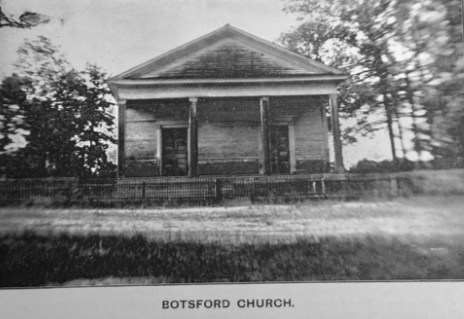
The Beginning
The history of Botsford Baptist Church begins with an orphan, Edmund Botsford, born at Wo-Burn, Bedfordshire, England, in 1745. At the age of 21, he sailed to the new world, arriving in Charleston, South Carolina, in January 1766. He was converted under the ministry of the Rev. Oliver Hart and united with the Charleston Baptist Church, where he was baptized in 1767.
After a four-year study and apprenticeship under the Rev. Hart, Edmund Botsford was licensed to preach in 1771. He preached his first sermons at Tuckasee King (Effingham County) and began a mission tour on horseback, preaching on both sides of the Savannah River in Georgia and South Carolina.
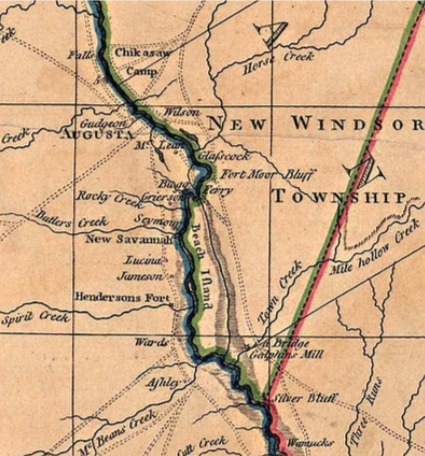
New Savannah Church
In 1772, the Rev. Botsford preached at New Savannah, a small town on the Georgia side of the Savannah River, located some 25 miles below Augusta. Here, he baptized converts as members of the church of Tuckasee King, regarding this as an arm of that church.
In November 1773, the Rev. Hart of Charleston, the Rev. Frances Pelot of Euhaw, South Carolina, and the Rev. Botsford, being the Presbytery, organized a church called “New Savannah.” The name was derived from its location.
Dr. Louie Newton, the widely known church historian, in his history given at the Botsford Bicentennial in 1973, stated that this church is actually a little older than Kiokee, but Kiokee received its charter first.
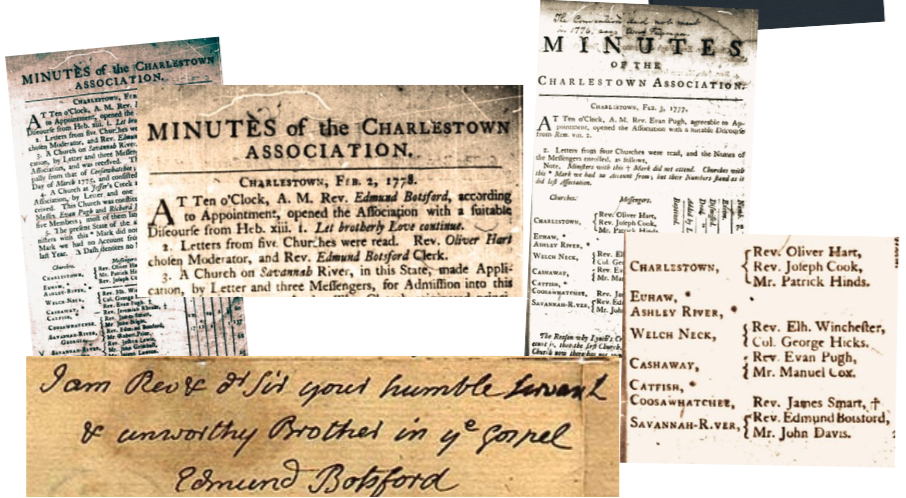
Charleston Association
Because there was no Association in Georgia at this time and because of the Rev. Botsford’s relationships in Charleston, the New Savannah Church joined the Charleston, South Carolina, Association in 1784.
In May 1774, the Rev. Botsford purchased land along Briar Creek in Burke County, Georgia, and expanded his efforts up and down the Savannah River to the Indian population, which was less than those further inland. His preaching brought converts.
One of his travels brought him to Augusta as the guest of Colonel Barnard, the justice before whom Daniel Marshall, the pastor of Kiokee Church, was tried for preaching in the parish of St. Paul.
In the records of the Charleston Association, it is documented for “New Savannah" Church:
Delegates Rev. E. Botsford & James Brewer for 1775. Delegates Rev. E. Botsford & John Davis for 1777. Delegates Rev. E Botsford & Robert Prior for 1778.
The same was repeated until 1791 when the names disappeared entirely from the table.
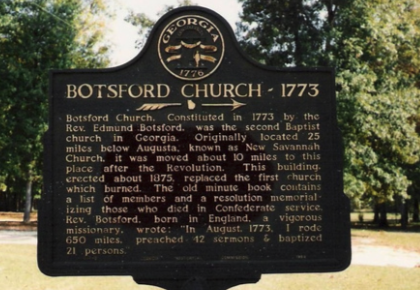
Briar Creek Church
After the close of the Revolutionary War, James Matthews gathered up the fragments of New Savannah (church) to a place near Briar Creek, some few miles from its present location.
It then became known as “Briar Creek.” Under the lead of its new pastor, it was united with the Georgia Association organized in 1784.
The first we see of the church is in the minutes of the Georgia Association in which the entry states that “Briar Creek, James Mathews, Moses Hadley, baptized 11, total 104.”
As there was soon a “Head of Briar Creek” in the Association, the next entry found is “1790 Lower Briar Creek: Elias Bailey, David McCullers, Moses Hadley: membership 102.” The next is for 1792, “Lower Briar Creek: Benjamin Davis, George Powell.”
Davis is entered as an ordained minister and is the same who labored with James Matthews in organizing Bethlehem (then Mobley’s Pond) and in organizing Big Buckhead.
Botsford Baptist Church became a member of the Hephzibah Association at its founding on September 27, 1794.

Botsford Baptist Church
Around the year 1800, the location of the church was again changed, and as it was no longer so near to Briar Creek, the name again changed. This time, it was named “Botsford," in honor of its founder, the Rev. Edmund Botsford.
The first entry on the minutes of the Association states “1804, Botsford: Edmund Lowe, Stephen Hyman, baptized 10, total 36.” Twenty years from that time its number of members was recorded as 27.
When the distinction was first given between the races, “the whites numbered 55, blacks numbered 84, and the total was 139.” The last year before the separation between the races took place (1867), the record was “whites, 84, blacks, 186, total 270.”
At the request of its black congregants who desired a church of their own, Botsford discontinued black membership in 1870.
At this time, the old building was given (by consent of white members) to the blacks, and with their help, was moved about one-half mile from the site and is presently known as “Bottsford Spring Baptist Church.”
The membership of Botsford in 1892 was reported at 77, and the Sabbath School was “teachers, 7, pupils, 40.”
Full-Time Ministry
Botsford Baptist became a full-time ministry in 1970. In January 1972, the mobile home serving as the pastorium was destroyed by a tornado. It was replaced with a three-bedroom brick house, which still stands next door.
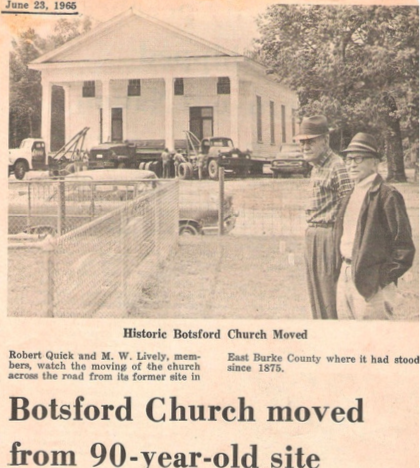
Until 1965, the church building sat across the road (on the north side of Botsford Church Road) from its present location. Since this move, which was covered by the newspaper on June 23, 1965, the congregation voted to add two wings for education space, with the west wing being completed in 1982.
In 1990 two front doors that had formerly separated men and women were replaced by one main door for all congregants.
In 1993, extra dining space was added to the social hall. Then, in 1996, educational rooms were removed from the balcony and it was remodeled for extra seating, increasing the capacity from 160 to 235.
Six new stained glass windows were also installed. A new kitchen was added in 1997, along with new educational rooms.
In 1998, the sanctuary was enlarged to seat nearly 300 people to accommodate a growing membership.
New pews and pulpit furniture were added. A new baptistry and nursery were also built onto the building.